Chamomile Flowers and Buds: From Blossom to Golden Cup
Share
A handful of dried chamomile tells the story of the flower. Some heads still have papery white rays around a yellow centre. Others are small and tightly closed. Add hot water and the dried botanicals release a soft floral aroma, turning the cup a clear, warm gold.
What are chamomile flowers and buds?
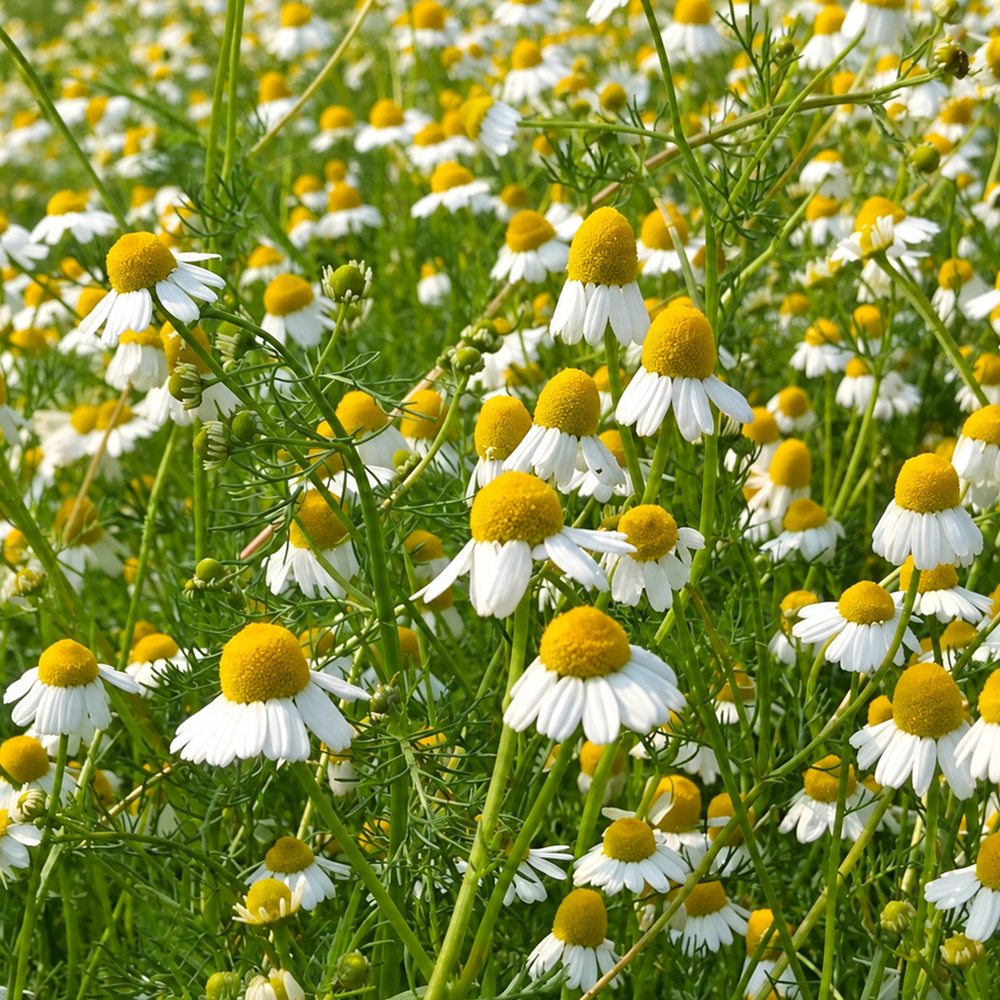
German chamomile (Matricaria chamomilla) belongs to the daisy family. An open chamomile head is made up of many tiny flowers. The yellow centre contains closely packed disc florets, while the white rays form the outer ring. A bud is a flower head that has yet to open fully. Once dried, buds tend to look compact, while open heads may retain some of their white rays.
The word whole describes the physical form. If you’re comparing whole chamomile flowers and buds, brew them side by side using the same weight, water and steeping time. Compare the aroma, colour and finish. This is a practical way to choose a format for your cup or blend.
What researchers found in brewed chamomile
A 2010 review by Srivastava, Shankar and Gupta describes the flavonoids and terpenoids found in chamomile flowers and identifies dried flowers as the basis of the familiar herbal infusion.
A 2012 study in Food Chemistry analysed 13 commercial German chamomile teas and their brewed infusions. The researchers measured polyphenols in the infusions and found differences across samples. The study gives useful context for comparing chamomile lots. For choosing what to serve, a side-by-side tasting can tell you how each lot performs in your own brewing setup.
How to brew whole chamomile
Start with about 2 g of food-grade dried chamomile for 200 ml of hot water.
Cover and steep for 5 minutes.
Strain into a clear cup to see the liquor colour. Taste the infusion plain before adding anything.
For a fuller cup, try a slightly longer steep on the next brew and compare the finish.
Pure chamomile is a naturally caffeine-free botanical infusion. If you choose a chamomile blend with green or black tea, the tea leaves contribute caffeine.
Research references
Srivastava JK, Shankar E, Gupta S. Chamomile: A herbal medicine of the past with bright future. Molecular Medicine Reports, 2010. Read the review
Raal A, Orav A, Püssa T, et al. Content of essential oil, terpenoids and polyphenols in commercial chamomile teas from different countries. Food Chemistry, 2012. Read the study abstract